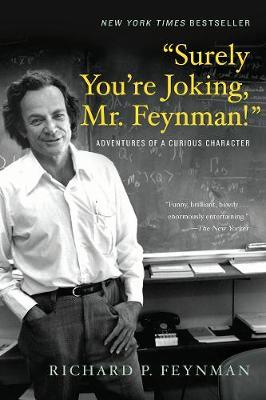

Richard Phillips Feynman (1918–1988) was an American theoretical physicist known for his work in quantum mechanics, quantum electrodynamics (QED), and particle physics. He was awarded the Nobel Prize in Physics in 1965, along with Julian Schwinger and Sin-Itiro Tomonaga, for their contributions to the development of QED, a quantum theory that describes how light and matter interact.
Feynman was also a gifted teacher and communicator of science, known for his ability to explain complex concepts in a clear and engaging manner. His style of teaching and his approach to problem-solving, often involving diagrams called Feynman diagrams, have had a lasting impact on the field of physics.
Beyond his scientific contributions, Feynman was a colorful and charismatic personality. He was known for his curiosity and enthusiasm for learning, as well as his interests outside of physics, including art, music, and safe-cracking. His autobiographical works, particularly "Surely You're Joking, Mr. Feynman!" and "What Do You Care What Other People Think?", reflect his adventurous spirit and unique perspective on life and science.
Feynman also played a significant role in the investigation of the Challenger space shuttle disaster, emphasizing the importance of transparency and the ethics of scientific responsibility. His legacy continues to inspire physicists and science enthusiasts around the world.
Richard P. Feynman, winner of the Nobel Prize in physics, thrived on outrageous adventures. In this lively work that "c...